
By using this site, you agree to the Privacy Policy and Terms of Use.
Accept
Monday, Jan 12, 2026
  • Politics
  • Society
  • World
  • Law and Crime
  • Economy
  • Technology
  • India
Search
Login
Champion Free Press
Support independent, fact-driven journalism at The News Drill. Your contribution helps us stay unbiased and uncompromised.
Support US
The News Drill Logo
  • Home
  • Politics
    PoliticsShow More
    Winter Session of Parliament
    President Droupadi Murmu Approves Winter Session of Parliament from December 1 to 19, 2025
    3 Min Read
    Winter Session of Parliament
    Bihar Elections 2025: Dularchand Yadav’s Killing in Mokama Sparks Political and Caste Repercussions
    10 Min Read
    Winter Session of Parliament
    “Sheesh Mahal 2.0”: BJP Shares Photo of Chandigarh Mansion Allegedly Allotted to Arvind Kejriwal, AAP Calls It ‘Fake Claim’
    6 Min Read
    Winter Session of Parliament
    Karnataka BJP Leader’s Son Caught Assaulting Toll Staff on CCTV for Denied Free Pass
    3 Min Read
    Winter Session of Parliament
    Karnataka Caste Survey 2025: A Tool for Social Justice or Prelude to Wealth Redistribution?
    7 Min Read
  • World
    World
    Show More
    Top News
    Elon Musk vs. Donald Trump: Former Allies Turn Foes in Explosive Blame Game
    July 19, 2025
    Winter Session of Parliament
    Qatar Confirms Talks with IOC to Host 2036 Summer Olympics
    July 24, 2025
    Winter Session of Parliament
    Indian Techie Shot Dead By US Police, Family Alleges Racial Harassment
    September 19, 2025
    Latest News
    Pakistan-Based Asia One News’ X Account Withheld in India After Legal Demand
    January 10, 2026
    Ganga Water Treaty and the 2026 Deadline: What India and Bangladesh Are Really Negotiating
    January 2, 2026
    Indian-Origin Woman Detained by ICE During Final Stage of Green Card Process Sparks Outrage in US
    December 16, 2025
    India–Russia Summit 2025: Major Announcements as Putin’s Two Day Visit Enters Day 2
    December 5, 2025
  • Law and Crime
  • Economy
Reading: Basic Customs Duty on Imported Crude Edible Oils Reduced to 10%
Explore by Topics
Subscribe
Font ResizerAa
The News DrillThe News Drill
  • Law and Crime
  • Opinions and Analysis
  • Defence
  • Society
  • Editorial
  • Politics
  • World
  • Business
  • Technology
Search
  • Home
    • Sitemap
  • Post Submission
    • Submit a Post
    • Edit Your Submission
    • Review and Manage Your Posts
    • Submit a Tip / Report a Story
  • Profile
    • Password Reset
    • Member Login
    • Registration
    • Join Us
    • Login
  • About Us
    • Contact
    • Become a Sponsor
    • Support The News Drill
    • Advertise With Us
Have an existing account? Sign In
Follow US
© 2026 The News Drill Network. All Rights Reserved.
The News Drill > Blog > Economy > Basic Customs Duty on Imported Crude Edible Oils Reduced to 10%
EconomyPoliticsSociety

Basic Customs Duty on Imported Crude Edible Oils Reduced to 10%

Parihar Rishabh Singh
Last updated: July 5, 2025 12:37 PM
By
Parihar Rishabh Singh
ByParihar Rishabh Singh
Founder & Managing Editor
Parihar Rishabh Singh is the Founder, Managing Editor, and Main Author of The News Drill, an Indian digital news platform committed to factual, unbiased reporting. Holding a...
Follow:
- Founder & Managing Editor
9 Min Read
Share
SHARE
Basic Customs Duty on Imported Crude Edible Oils Reduced to 10%

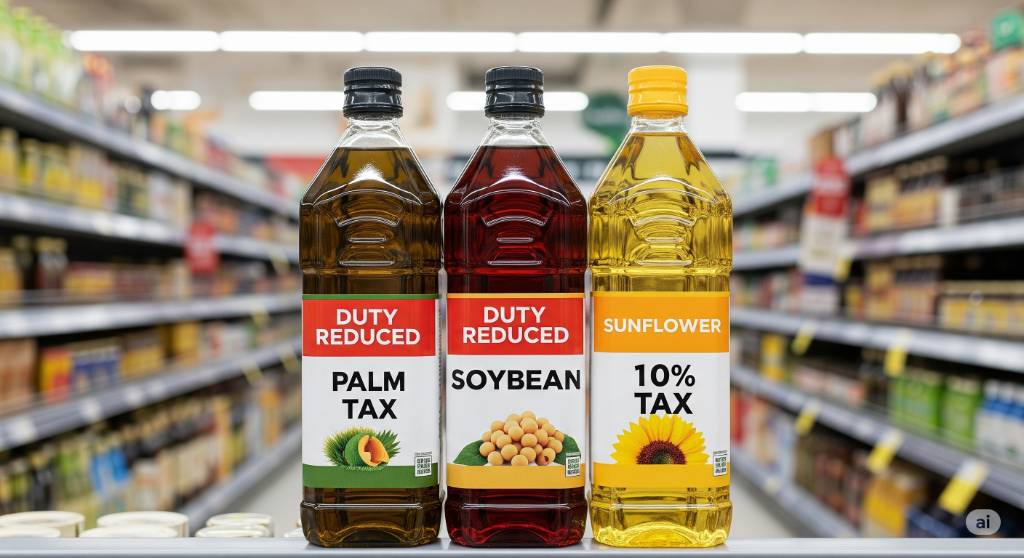
In a significant step aimed at tackling food inflation and easing the financial burden on households, the Central Government has announced a reduction in the basic customs duty on imported crude edible oils. This strategic decision will see the duty rate lowered from 20% to 10% for key edible oils such as crude sunflower oil, crude soybean oil, and crude palm oil.

Contents
  • Why the Government Reduced Basic Customs Duty on Imported Crude Edible Oils
  • India’s Dependence on Imported Edible Oils
  • Impact on Retail Prices and Household Budgets
  • Inflation Control and Economic Implications
  • Boost to Domestic Refining Sector
  • Farmer Impact: Neutral to Slightly Positive
  • Government’s Statement and Industry Response
  • Global Market Context
  • Future Outlook
  • Conclusion

The revision in the basic customs duty on imported crude edible oils comes at a critical juncture when domestic prices of essential commodities are surging due to global supply constraints and rising international prices. This move is expected to have a cascading positive impact on retail prices, household budgets, inflation control, and the domestic edible oil processing sector.

Why the Government Reduced Basic Customs Duty on Imported Crude Edible Oils

The central idea behind the government’s decision is to ease the burden on Indian consumers who have been grappling with soaring prices of cooking oils for over a year now. India imports nearly 60% of its edible oil requirement, making domestic prices highly sensitive to international price fluctuations, geopolitical tensions, and global weather events.

The basic customs duty on imported crude edible oils was earlier pegged at 20%, which added significant cost overheads to importers. These costs were ultimately passed on to consumers, contributing to household inflation. By slashing the import duty to 10%, the government expects to bring down the overall cost structure of these essential commodities.

India’s Dependence on Imported Edible Oils

India is one of the largest importers of edible oils globally. The country relies heavily on imports of:

More Read

Winter Session of Parliament
Bihar Becomes First State Where Jewellers Restrict Gold Sales to Face-Covered Customers
Ganga Water Treaty and the 2026 Deadline: What India and Bangladesh Are Really Negotiating
Gwalior Engineer Dies by Suicide Amid POCSO Case; Family Alleges Extortion Pressure
After Santosh Verma Row, IAS Meenakshi Singh’s Caste Identity Statement at AJJAKS Event in Bhopal Ignites Fresh Debate
Centre to Repeal MGNREGA, Introduce VB-G RAM G Bill 2025: What Changes for Rural India?
  • Palm oil (mainly from Indonesia and Malaysia).
  • Soybean oil (primarily from Argentina and Brazil).
  • Sunflower oil (largely from Ukraine and Russia).

This over reliance on imported oils means that any fluctuation in international prices, currency exchange rates, or export restrictions by other countries directly affects Indian prices. Hence, the basic customs duty on imported crude edible oils plays a critical role in determining local affordability.

Impact on Retail Prices and Household Budgets

The government’s decision to reduce the basic customs duty on imported crude edible oils is expected to lower retail prices significantly. The Ministry of Consumer Affairs has indicated that edible oil manufacturers and traders have been directed to pass on the benefits of the duty cut to consumers without delay.

A 10% reduction in customs duty is likely to reduce MRP (Maximum Retail Prices) by ₹8 to ₹12 per litre, depending on the oil type and packaging costs. For middle class families and economically weaker sections, this price relief comes as a welcome respite, especially as inflation remains a concern.

Inflation Control and Economic Implications

Food inflation has been a persistent issue in India, with cooking oils contributing heavily to it. According to recent Consumer Price Index (CPI) data, the edible oils category showed a YoY inflation of over 12% in several months of 2024–25. By reducing the basic customs duty on imported crude edible oils, the government expects to curb the inflationary trend and stabilize food prices.

Moreover, lower oil prices may free up household income for other essentials, leading to better consumption trends and positive multiplier effects in the economy. This policy shift is thus both consumer friendly and inflation sensitive.

Boost to Domestic Refining Sector

Apart from providing relief to consumers, this policy also supports the domestic refining industry. Since the duty cut is applicable only to crude edible oils (and not refined oils), it creates a favourable gap that encourages the import of raw oil and its processing within India. This provides:

  • Increased refining margins for Indian units.
  • Boost in employment in the food processing sector.
  • Strengthening of value added production.
  • Reduction in import of already refined oils, thus supporting Make in India goals.

The basic customs duty on imported crude edible oils thus becomes a strategic lever to balance both consumer welfare and industrial policy.

Farmer Impact: Neutral to Slightly Positive

Some voices within the domestic agriculture sector had initially raised concerns about the implications for oilseed farmers, fearing that cheaper imports might depress local prices. However, the 10% duty still maintains a sufficient buffer to protect farmer interests. Additionally:

  • MSP (Minimum Support Prices) for oilseeds have seen steady hikes.
  • Domestic oilseed demand remains robust.
  • Government procurement of soyabean and mustard has improved.

Thus, the policy is expected to remain neutral to positive for Indian farmers while simultaneously helping consumers.

Government’s Statement and Industry Response

In its official notification, the Finance Ministry emphasized that the decision to cut the basic customs duty on imported crude edible oils aligns with the government’s broader objective to make essential commodities affordable. The ministry also said that it is closely monitoring retail prices and would take further corrective steps if needed.

Industry bodies such as the Solvent Extractors’ Association of India (SEA) and Indian Vegetable Oil Producers’ Association (IVPA) have welcomed the move and assured the public that they would ensure a pass through of cost savings to the end consumer.

Global Market Context

Globally, edible oil prices have been under pressure due to:

  • Climate change-induced supply shocks.
  • The Russia-Ukraine war, affecting sunflower oil exports.
  • Indonesia’s temporary bans on palm oil exports.
  • Currency fluctuations and freight cost increases.

In this context, reducing the basic customs duty on imported crude edible oils enhances India’s ability to smooth out local supply side volatility and remain competitive in global pricing terms.

Future Outlook

Looking ahead, the government is expected to:

  • Continue closely monitoring inflationary trends.
  • Explore further rationalization of import duties if required.
  • Promote oilseed cultivation under Atmanirbhar Bharat to reduce long term dependence on imports.

A balanced and responsive trade policy, like the current decision on the basic customs duty on imported crude edible oils, signals the government’s commitment to price stability, food security, and industrial development.

Conclusion

The reduction in the basic customs duty on imported crude edible oils is a timely and strategic move by the Government of India. It not only addresses the pressing issue of rising edible oil prices but also helps in reducing inflation, supporting domestic refining units, and relieving pressure on household budgets.

By ensuring the benefits reach consumers directly and encouraging the edible oil industry to act responsibly, the policy also sets a precedent for collaborative inflation control in essential food sectors.

As edible oil remains a staple in every Indian kitchen, this reform has the potential to touch millions of lives positively reaffirming the role of intelligent fiscal policy in everyday affordability.

Stay Connected with The News Drill for more updates on trade policy, inflation control, and food pricing.

Contact us: contact@thenewsdrill.com

Submit tips or industry stories: editor@thenewsdrill.com

Follow us on X (formerly Twitter) for real time economic policy alerts.

Reserved-Category Students Now Form Majority in Indian Higher Education: IIM Udaipur Study
VIT Bhopal Unrest: Students Protest Over Alleged Jaundice Cases, Campus Shut Pending Inquiry
Cancellation to Reservation: Major IRCTC Services to Remain Down on November 22 for System Upgrade
Muzaffarnagar Student Ujjwal Rana Dies After Self Immolation Over ₹7,000 Fee Dispute at DAV College
President Droupadi Murmu Approves Winter Session of Parliament from December 1 to 19, 2025
TAGGED:Edible Crude oil import duty reduced
Share This Article
Facebook Whatsapp Whatsapp Telegram Threads Copy Link
ByParihar Rishabh Singh
Founder & Managing Editor
Follow:
Parihar Rishabh Singh is the Founder, Managing Editor, and Main Author of The News Drill, an Indian digital news platform committed to factual, unbiased reporting. Holding a B.Sc. in Mathematics and an M.Sc. in Statistics with expertise in Statistics, he brings analytical depth to investigative and data-driven journalism. He is also a dedicated UPSC and GPSC aspirant. A disciplined former NCC cadet with A Grade in Certificates C, B, and A, and a football player, he values precision, discipline, and teamwork. His skill set includes fact-checking, reverse image search, and thorough verification of sources. He also contributed to the 2022 National Games as part of the GMS team. His reporting spans geopolitics, international relations, politics, society, the Indian economy, environment & ecology, technology, crime, law and justice, education, and public policy. Through The News Drill, he aims to combine rigorous research with clear, accessible journalism that informs and empowers readers.
Previous Article Winter Session of Parliament #YeThikKarkeDikhao Viral Movement Exposes India’s Ground Realities
Next Article Winter Session of Parliament After SC Verdict on OBC Quota, Is Reservation Killing Meritocracy? As the World Moves Forward, Is India Moving Backward?
Leave a Comment

Click here to cancel reply.

Please Login to Comment.

Follow US

866.6KFollowersLike
487.6KFollowersFollow
577.5KFollowersFollow
998.8KSubscribersSubscribe
132.5KFollowersFollow
758.5KFollowersFollow

Must Read

July 20, 2025

India’s Strategic Might: Why It Ranks 4th on the Global Firepower Index

Indian Missiles
Winter Session of Parliament

Pakistan-Based Asia One News’ X Account Withheld in India After Legal Demand

Winter Session of Parliament

Bihar Becomes First State Where Jewellers Restrict Gold Sales to Face-Covered Customers

Winter Session of Parliament

Ganga Water Treaty and the 2026 Deadline: What India and Bangladesh Are Really Negotiating

Winter Session of Parliament

Unnao Rape Case: A Legal Re-Examination of the Conviction, Contradictions, and Questions Before the High Court

Winter Session of Parliament

Gwalior Engineer Dies by Suicide Amid POCSO Case; Family Alleges Extortion Pressure

- The News Drill: Reach & Impact -
Ad imageAd image

You Might Also Like

Winter Session of Parliament
Economy

Samadhan Yojana 2025-26: CM Mohan Yadav Launches Scheme for Electricity Bill Relief in Madhya Pradesh

7 Min Read
Winter Session of Parliament
Politics

Bihar Elections 2025: Dularchand Yadav’s Killing in Mokama Sparks Political and Caste Repercussions

10 Min Read
Winter Session of Parliament
Politics

“Sheesh Mahal 2.0”: BJP Shares Photo of Chandigarh Mansion Allegedly Allotted to Arvind Kejriwal, AAP Calls It ‘Fake Claim’

6 Min Read
Winter Session of Parliament
SocietyOpinions and Analysis

India will not become a developed country IF this continues

5 Min Read

The Daily Newsletter

Brings you a selection of the latest news, trends, insights, and tips from around the world.

About US

The News Drill delivers clear, factual and independent reporting on India’s most important developments. We cut through noise, avoid sensationalism, and focus on verified, high-impact stories that matter.

Support US
  • India
  • World
  • Sports
  • Politics
  • Society
  • Editorial
  • Defence
  • Business
  • Economy
  • Fact Check
  • Technology
  • Law and Crime
  • Opinions and Analysis

More Links

  • Sitemap
  • Disclaimer
  • Opportunities
  • Privacy Policy
  • Editorial Policy
  • Terms & Conditions
  • Credits & Acknowledgements
© 2026 The News Drill Network. All Rights Reserved.
Subscribe Newsletter
  • Daily Stories
  • Stock Arlets
  • Full Acess
Subscribe to our newsletter to get our newest articles instantly!
Welcome Back!

Sign in to your account

Username or Email Address
Password

Lost your password?