
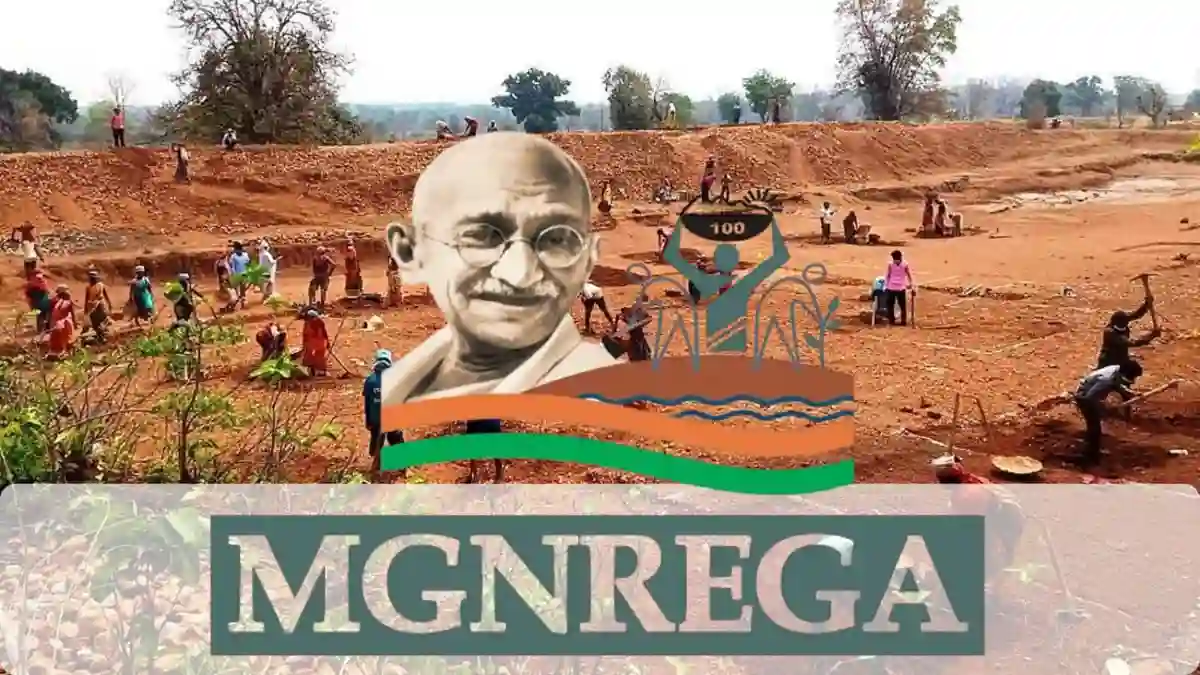
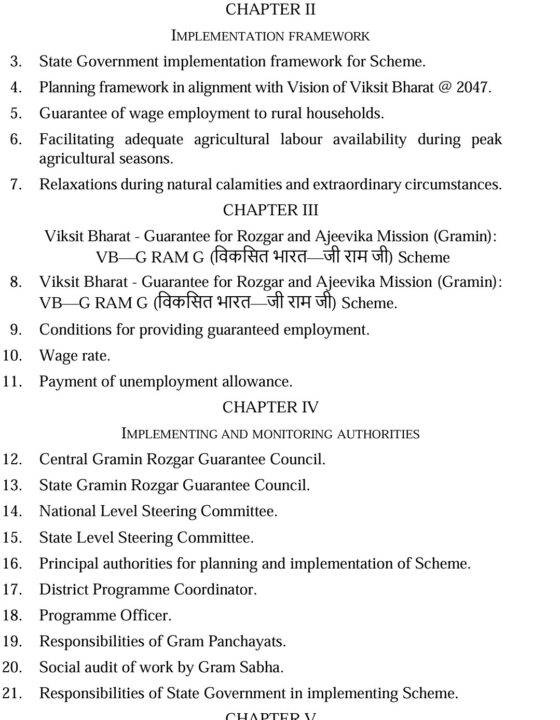
In a major shift in India’s rural employment policy, the Union government is set to introduce the VB-G RAM G Bill 2025 in Parliament, formally repealing the Mahatma Gandhi National Rural Employment Guarantee Act (MGNREGA), 2005. The proposed legislation officially titled The Viksit Bharat Guarantee for Rozgar and Ajeevika Mission (Gramin) Bill, 2025 aims to replace the existing demand driven employment guarantee framework with a new, centrally structured model aligned with the government’s Vision Viksit Bharat @2047.
- From MGNREGA to VB-G RAM G Bill 2025: What Is Changing?
- 125 Days on Paper, But With Conditions
- Cost Sharing: States to Bear Higher Financial Burden
- End of Demand-Driven Employment?
- Pause During Peak Agricultural Season
- Why the Government Says Reform Is Needed
- Concerns Over Worker Rights and Federal Balance
- A Turning Point for Rural Employment Policy
If passed, the VB-G RAM G Bill 2025 will mark the biggest overhaul of rural wage employment since MGNREGA came into force two decades ago.
From MGNREGA to VB-G RAM G Bill 2025: What Is Changing?
Under MGNREGA, every rural household with adult members willing to do unskilled manual work is legally entitled to at least 100 days of wage employment per financial year. The scheme has functioned on a demand driven basis, meaning states were required to provide work whenever demand was generated, with the Centre largely bearing wage costs.
The VB-G RAM G Bill 2025, however, restructures this entitlement in fundamental ways:
- Guaranteed workdays increase from 100 to 125 days.
- States will now share wage costs with the Centre.
- Demand driven architecture is replaced by “normative allocation.”
- Work may be paused during peak agricultural seasons.
125 Days on Paper, But With Conditions
One of the headline promises of the VB-G RAM G Bill 2025 is the increase in guaranteed employment from 100 to 125 days per rural household annually. On paper, this appears to be an expansion of workers’ rights.
More Read

However, data from recent years raises questions about real world implementation. In 2024–25, the average employment provided per household under MGNREGA was only about 50 days. While 40.7 lakh households completed 100 days last year, in the current financial year only 6.74 lakh households reached that ceiling.
Critics argue that unless structural bottlenecks are addressed, increasing the statutory limit to 125 days under the VB-G RAM G Bill 2025 may remain largely symbolic.
Cost Sharing: States to Bear Higher Financial Burden
A major departure under the VB-G RAM G Bill 2025 is the introduction of mandatory cost-sharing for wages, ending the Centre’s practice of fully funding unskilled labour wages.
The proposed funding structure is as follows:
- 60:40 Centre–State split for most states.
- 90:10 split for Northeastern and Himalayan states, including Uttarakhand, Himachal Pradesh, and Jammu & Kashmir.
- 100% central funding only for Union Territories without legislatures.
Under MGNREGA, the Centre paid the full wage bill, while states were responsible mainly for unemployment allowances and partial material costs. The VB-G RAM G Bill 2025 shifts a substantial financial responsibility onto states, many of which are already fiscally constrained.
Policy analysts warn this could lead to reduced work generation, especially in poorer states unable to fund their share.
End of Demand-Driven Employment?
Perhaps the most consequential change under the VB-G RAM G Bill 2025 is the introduction of “state-wise normative allocation.”
Unlike MGNREGA’s labour budget system where states submitted annual demand based plans the new Bill empowers the Centre to pre-fix annual allocations for each state using “objective parameters.” Any expenditure beyond this ceiling must be borne entirely by the state.
This effectively dismantles the open-ended, rights based framework of MGNREGA. Under the VB-G RAM G Bill 2025, employment is no longer guaranteed by demand alone, but constrained by budgetary limits.
Pause During Peak Agricultural Season
The VB-G RAM G Bill 2025 also allows states to suspend scheme work for up to 60 days annually during peak agricultural seasons to ensure adequate farm labour availability.
States can issue region specific notifications based on crop cycles, climate zones, or local conditions. While the government argues this will prevent labour shortages during sowing and harvesting, worker groups say it shrinks the effective window for accessing the promised 125 days of work.
In practice, this means rural households may have fewer days available to claim employment, even though the statutory guarantee has increased
Why the Government Says Reform Is Needed
The government’s push for the VB-G RAM G Bill 2025 follows a report by a committee constituted by the Ministry of Rural Development in 2022. The panel examined governance issues, fund utilisation, and uneven performance across states.
According to the government, the new framework will:
- Improve fiscal discipline
- Align rural employment with agricultural cycles
- Integrate livelihood creation with long-term rural development
- Support the broader Vision Viksit Bharat @2047 agenda
Officials also argue that MGNREGA, over time, became more of a social security fallback rather than a productivity linked employment programme.
Concerns Over Worker Rights and Federal Balance
Opposition parties, labour unions, and rural activists have raised serious concerns about the VB-G RAM G Bill 2025.
Key apprehensions include:
- Dilution of the legal right to work.
- Increased dependence on state finances.
- Reduced bargaining power of rural workers.
- Centralisation of control over employment allocation.
Experts caution that replacing MNREGA’s rights based design with a budget capped scheme could weaken rural distress support during economic shocks, droughts, or migration crises.
A Turning Point for Rural Employment Policy
There is little doubt that the VB-G RAM G Bill 2025 represents a historic turning point in India’s rural employment architecture. While the promise of more workdays and livelihood integration is politically appealing, the shift away from demand driven guarantees fundamentally alters the social contract established in 2005.
As the Bill is introduced in Parliament, its fate will depend not just on numbers in the Lok Sabha, but on whether lawmakers can reconcile fiscal discipline with the constitutional promise of livelihood security for India’s rural poor.
For millions who rely on wage employment for survival, the real test of the VB-G RAM G Bill 2025 will not be its intent but its implementation.
Stay tuned with The News Drill for more updates & follow on X for live updates.