
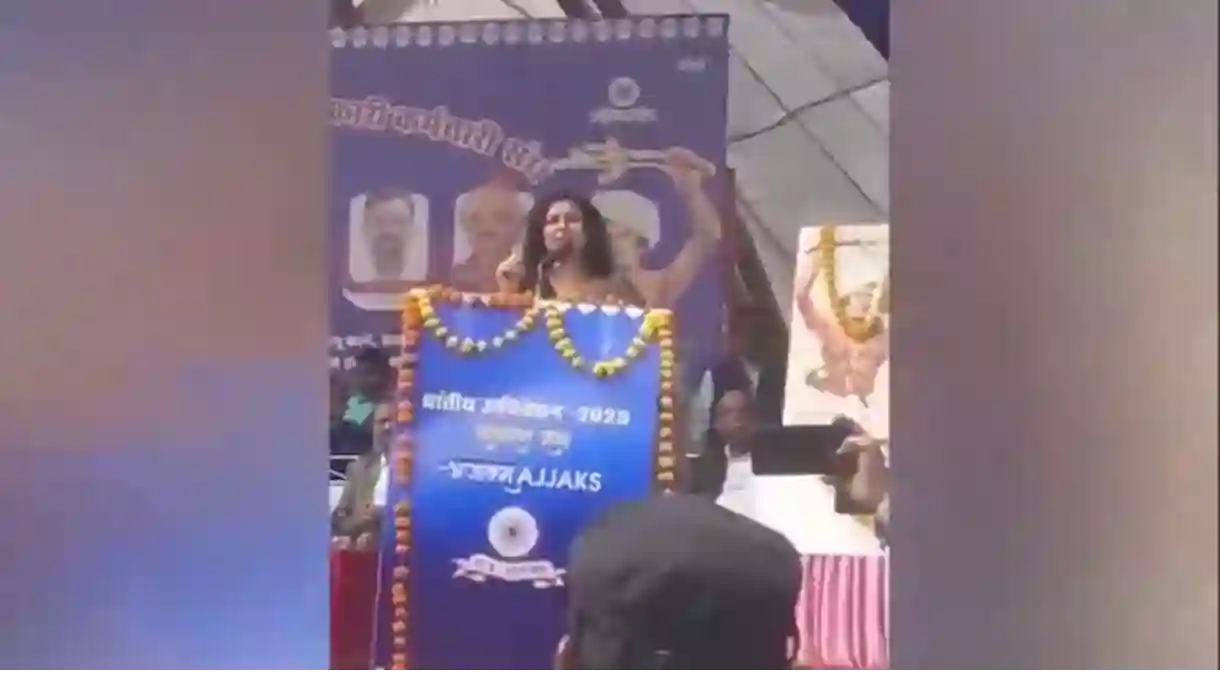
Bhopal: The IAS Meenakshi Singh controversy has once again brought the sensitive issue of caste identity into national focus. Just days after the debate surrounding IAS Santosh Verma, a fresh discussion has emerged in Madhya Pradesh following remarks made by IAS officer Meenakshi Singh at an AJJAKS (Anusuchit Jati Janjati Adhikari Evam Karmachari Sangh) event in Bhopal. A video clip of her speech has gone viral on social media, drawing strong reactions from different sections of society.
What Did IAS Meenakshi Singh Say?
At a public gathering held at Ambedkar Park, Bhopal, IAS Meenakshi Singh spoke about the role of caste identity in today’s society. Referring to social realities, she stated that “caste identity and being caste conscious is the biggest demand of today’s time.” She further urged members of the Scheduled Caste and Scheduled Tribe communities to remain connected with their roots and support each other within institutional frameworks.
According to her, social networks based on surnames and caste affiliations already influence decision making in many spheres. In this context, she argued that marginalized communities must also recognize their collective identity to ensure mutual support and representation.
These remarks quickly became the center of the IAS Meenakshi Singh controversy, particularly among sections of the Savarna community, who viewed the statements as divisive.
Emphasis on Family and Social Awareness
During her address, the officer stressed that social awareness begins at home. She encouraged parents to openly discuss caste identity with their children, not as a tool of exclusion, but as a way of understanding social history and structural challenges.
More Read

She said that many SC/ST individuals hesitate to approach senior officers from their own community, often due to fear or social distance. Addressing this issue, she publicly invited people from her community to meet her freely, even without official grievances, to strengthen dialogue and trust.
Supporters argue that this aspect of her speech has been overlooked in the larger IAS Meenakshi Singh controversy, which has largely focused on selective excerpts from the viral video.
Reaction from Savarna Groups
The IAS Meenakshi Singh controversy has generated visible discontent among Savarna organizations and individuals, particularly on social media. Critics question whether such statements would be acceptable if made by officers from upper-caste backgrounds. Some argue that repeated generalizations about caste privilege risk deepening social divides rather than addressing inequality.
However, no official complaint or disciplinary action has been announced so far, and the state administration has not issued a formal statement on the matter.
Who Is IAS Meenakshi Singh?
IAS Meenakshi Singh is a 2013 batch Indian Administrative Service officer from the Madhya Pradesh cadre. She was promoted to the IAS and currently serves as Deputy Secretary in the Scheduled Caste Welfare Department. As of 2025, she has also held additional responsibilities related to tribal and SC development programs.
She has publicly identified herself as belonging to the Scheduled Caste and Tribal community and has been associated with AJJAKS, an organization representing SC/ST officers and employees.
Her administrative career has largely focused on welfare oriented departments, which supporters say adds context to her remarks amid the ongoing IAS Meenakshi Singh controversy.
Official Response Awaited
Her detailed clarification on the viral remarks is still awaited.
Larger Debate on Caste and Governance
The IAS Meenakshi Singh controversy reflects a broader national debate on caste, representation, and social equity within India’s administrative framework. While one section views her statements as an assertion of social reality and empowerment, others perceive them as incompatible with the ideal of caste-neutral governance.
Experts note that such debates underline the complexity of balancing constitutional equality with lived social experiences. Whether the controversy will lead to policy discussions or administrative guidelines remains to be seen.
Conclusion
As discussions continue, the IAS Meenakshi Singh controversy highlights the enduring sensitivity of caste discourse in India. With strong opinions on both sides, the episode underscores the need for measured dialogue, factual context, and institutional clarity especially when statements by senior civil servants enter the public domain.
For now, the matter remains a topic of public debate, awaiting an official response from the officer herself and, possibly, from the state administration.
Stay tuned with The News Drill for more updates and follow us on X for real time updates.