
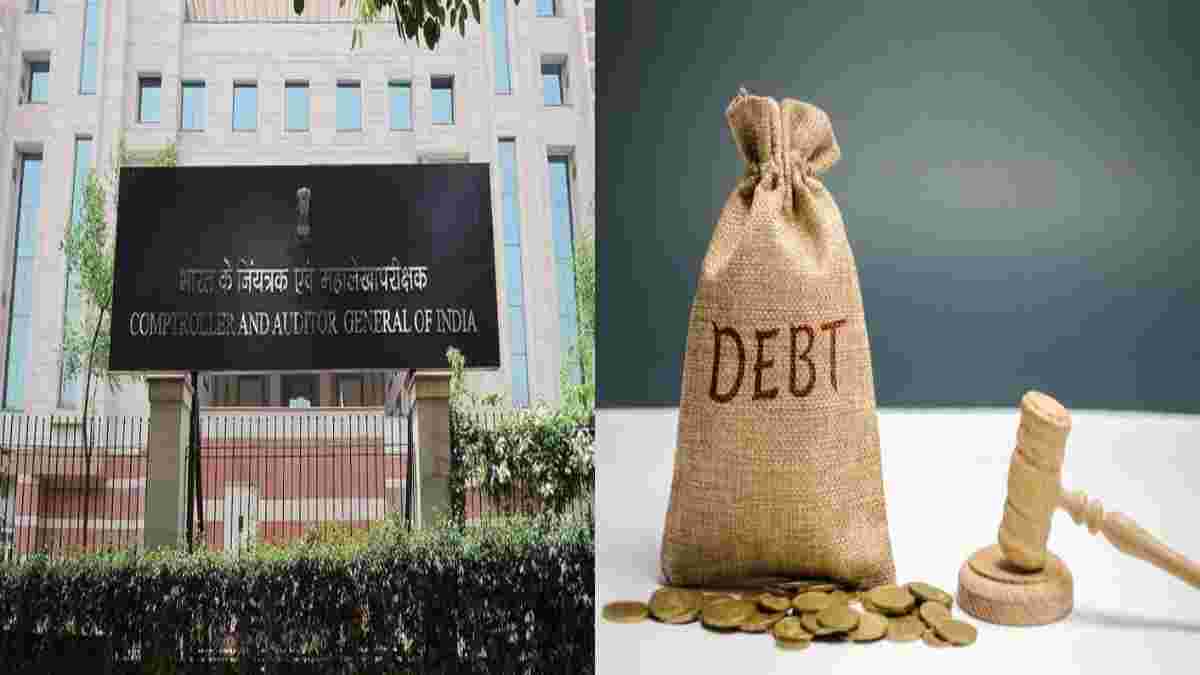
The latest report by the Comptroller and Auditor General of India (CAG) has revealed a significant increase in state debt in India over the last decade. According to the findings, the combined public debt of 28 states has nearly trebled in ten years, highlighting concerns about fiscal sustainability, rising liabilities, and the quality of expenditure by state governments.
- Debt Triples in a Decade
- Top 10 States with Highest Debt to GSDP Ratio
- Top 10 Indian States / UTs by Debt-to-GSDP Ratio (FY 2025-26 estimates)
- Debt as a Share of National Economy
- Sources of State Debt
- The “Golden Rule” of Borrowing
- Revenue Receipts and Debt Burden
- Rising Risks Ahead
- Way Forward: Reducing State Debt in India
- Conclusion
Debt Triples in a Decade
In 2013-14, the total public debt of Indian states stood at ₹17.57 lakh crore. By the end of FY 2022-23, this figure had risen to ₹59.60 lakh crore, marking an increase of 3.39 times. When measured against the Gross State Domestic Product (GSDP), state debt has grown from 16.66% to 22.96% during this period. This indicates that the burden of debt has been rising faster than the overall economic output of states.
The CAG presented the findings during the State Finance Secretaries Conference. The report offers a first of its kind decadal analysis of state debt in India, providing a clearer picture of how state finances have evolved.
Top 10 States with Highest Debt to GSDP Ratio
At the end of FY 2022-23, Punjab reported the highest debt to GSDP ratio in the country, standing at 40.35%. This means that for every ₹100 of output, Punjab’s debt liability was over ₹40. Following Punjab, Nagaland recorded a ratio of 37.15%, and West Bengal stood at 33.70%.
Other states with high levels of debt compared to their GSDP included Rajasthan, Kerala, Bihar, Andhra Pradesh, and Himachal Pradesh. These states, along with Punjab and West Bengal, fall into the category of states where public debt exceeds 30% of GSDP. On the other hand, Odisha (8.45%), Maharashtra (14.64%), and Gujarat (16.37%) reported the lowest ratios, indicating stronger fiscal health.The report classified states into three groups:
More Read

- Eight states with debt-to-GSDP above 30%.
- Fourteen states with debt between 20% and 30%.
- Six states with debt below 20%.
This distribution underscores the uneven burden of state debt in India.
Top 10 Indian States / UTs by Debt-to-GSDP Ratio (FY 2025-26 estimates)
| Rank | State / UT | Debt-to-GSDP (%) | Notes |
|---|---|---|---|
| 1 | Jammu & Kashmir | ~51.0% | Highest ratio among states/UTs for FY 2025-26 estimates. |
| 2 | Nagaland | ~48.0% | Substantially above the national state-average debt-to-GSDP. |
| 3 | Arunachal Pradesh | ~46.0% | High fiscal deficit and elevated borrowing dependency. |
| 4 | Punjab | ~44.5% | One of the largest state-level debt burdens relative to GSDP. |
| 5 | Himachal Pradesh | ~40.5% | High debt share driven by capital and revenue liabilities. |
| 6 | Mizoram | ~38.8% | Small GSDP base amplifies the ratio effect of borrowings. |
| 7 | Sikkim | ~38.2% | High borrowing relative to a compact state economy. |
| 8 | West Bengal | ~38.0% | Large absolute liabilities and elevated ratio to GSDP. |
| 9 | Meghalaya | ~37.6% | High ratio partially due to limited revenue base. |
| 10 | Bihar | ~37.0% | One of the highest among larger states by population. |
Debt as a Share of National Economy
The public debt of all states together accounted for 22.17% of India’s GDP in 2022-23. In absolute terms, the GSDP of the states was ₹2,59,57,705 crore, against which their combined debt stood at ₹59,60,428 crore. This reflects how deeply state debt in India is intertwined with the overall macroeconomic picture of the country.
Sources of State Debt
The report outlined that state borrowings include loans raised from the open market through securities, treasury bills, and bonds. Additional sources include borrowings from banks such as the State Bank of India, Ways and Means Advances from the Reserve Bank of India, and loans from institutions like LIC and NABARD.
Such borrowings are intended to finance infrastructure and capital expenditure. However, the CAG report warns that many states are increasingly using debt to fund operating costs rather than long term assets.
The “Golden Rule” of Borrowing
One of the key observations of the report relates to the principle of responsible borrowing. The “golden rule of borrowing” suggests that governments should borrow primarily to invest in capital projects and not to finance recurring expenses. However, the CAG found that 11 states – Andhra Pradesh, Assam, Bihar, Haryana, Himachal Pradesh, Kerala, Mizoram, Punjab, Rajasthan, Tamil Nadu, and West Bengal were using borrowed funds to meet their day to day expenditure needs.
For instance, in Andhra Pradesh and Punjab, capital expenditure was only 17% and 26% respectively of their net borrowings. Similarly, in Haryana and Himachal Pradesh, just about 50% of the borrowed funds went into capital investments. This practice undermines long-term financial sustainability and raises questions about fiscal discipline.
Revenue Receipts and Debt Burden
The report also highlighted that as a percentage of revenue receipts, state debt has ranged between 128% in FY 2014-15 and 191% in FY 2020-21. On average, the debt burden of states has been around 150% of their annual revenue receipts, which shows a high level of dependency on borrowings. In years such as 2020-21, the ratio spiked due to reduced economic activity during the Covid-19 pandemic.
Rising Risks Ahead
The sharp growth in state debt in India poses risks for future fiscal management. Rising liabilities mean a growing share of state revenues will be diverted toward interest payments, leaving less room for development spending. The CAG report points out that the debt trajectory is not sustainable if states continue to finance recurring expenditures through borrowings.
At a national level, policymakers face the challenge of balancing fiscal flexibility for states while ensuring adherence to prudent financial management. The increasing reliance on debt in states like Punjab, West Bengal, and Rajasthan highlights the urgency for structural reforms and better fiscal responsibility mechanisms.
Way Forward: Reducing State Debt in India
1. Strict Adherence to the Golden Rule:
States must borrow only for capital expenditure (roads, infrastructure, health facilities, irrigation, power) and avoid using debt for routine expenses like salaries, subsidies, or interest payments.
2. Enhancing Revenue Mobilisation:
Broaden tax base by improving GST compliance, strengthening property tax systems, and reducing leakages. Boost non-tax revenues through rational user charges for electricity, water, and transport services.
3. Expenditure Rationalisation:
Prioritise spending on growth-enhancing sectors (infrastructure, education, health). Cut down on populist subsidies and freebie schemes that create recurring liabilities without long-term economic benefits.
4. Debt Management Framework:
States should set up independent Debt Management Cells to monitor borrowings and repayment schedules. Adopt medium term fiscal plans with clear debt reduction targets in line with the FRBM (Fiscal Responsibility and Budget Management) Act.
5. Promoting Public-Private Partnerships (PPP):
Instead of debt-funded projects, leverage PPPs for infrastructure development, reducing the financial burden on state exchequers.
6. Better Utilisation of Borrowings
Ensure borrowed funds generate economic returns—projects financed by loans should contribute to growth, increase tax revenues, and strengthen the repayment capacity of states.
7. Transparency & Accountability:
Regular CAG audits and public disclosure of contingent liabilities (like guarantees to state enterprises) will improve accountability.
8. Centre-State Cooperation:
Union Government can design incentive-based transfers that reward states maintaining prudent fiscal discipline, while discouraging reckless borrowing.
In essence: To reduce the rising state debt in India, states need to shift from revenue driven borrowing to investment driven borrowing, expand their revenue base, cut wasteful expenditure, and institutionalise transparent debt management systems.
Conclusion
The CAG’s decadal analysis underscores the urgent need to strengthen fiscal discipline at the state level. While debt is an important tool for financing growth, the rising use of borrowings to cover revenue deficits threatens long-term financial stability. Going forward, states will need to realign their fiscal strategies to ensure that borrowings are used productively and that state debt in India remains sustainable in relation to both GSDP and revenue receipts.
Stay connected with The News Drill for more updates.