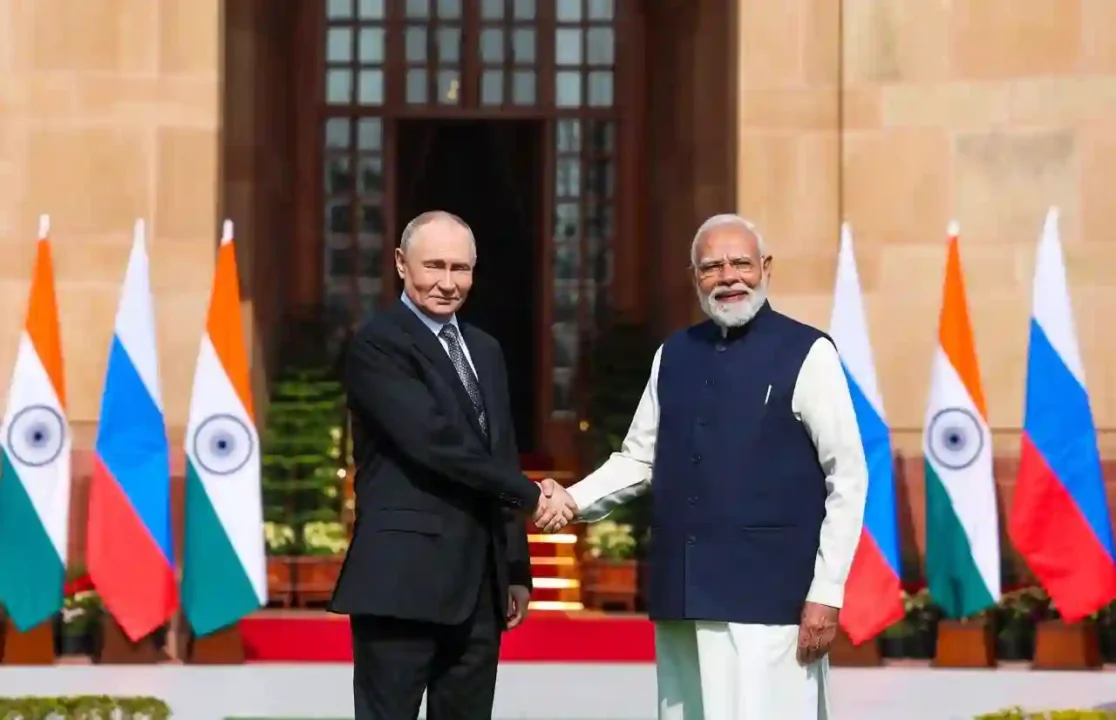
Russian President Vladimir Putin’s two day visit to India has entered its second day, bringing a series of high impact announcements that reaffirm the depth of the India–Russia strategic partnership. The India–Russia Summit 2025 has emerged as one of the most consequential diplomatic engagements of the year, setting the tone for bilateral cooperation across energy, defence, pharma, mobility, maritime connectivity and emerging technologies.
- Russia’s Big Technological Offer: Small Nuclear Reactors for India
- 30-Day Free e-Visa for Russian Tourists
- Putin: “Russia Is a Reliable Supplier for India’s Energy Needs”
- Push for India–Eurasian Economic Union Free Trade Agreement
- Strong Pitch for Trading in National Currencies
- India–Russia Economic Cooperation Roadmap 2030
- Major Pharma Factory in Russia Using Indian Technology
- Joint Production of Urea in India
- Training Indian Seafarers for Arctic Navigation
- Maritime Expansion: INSTC & Vladivostok–Chennai Corridor
- Mobility Pact & Shipbuilding Cooperation
- PM Modi Responds to Pahalgam Terror Attack & Calls for Peace in Ukraine
- 25 Years of a “Special & Privileged Strategic Partnership”
- India–Russia Summit 2025 Reshapes the Future of Bilateral Ties
As both leaders Prime Minister Narendra Modi and President Vladimir Putin met for extended talks, they unveiled an ambitious Economic Cooperation Roadmap 2030, strengthening long term trade and technological collaboration. The India–Russia Summit 2025 has also become a defining moment for India’s future in the Arctic, nuclear technology, and maritime expansion.
Russia’s Big Technological Offer: Small Nuclear Reactors for India
In a landmark announcement at the India–Russia Summit 2025, President Putin offered India small nuclear reactor (SMR) technology, seen as a critical step toward clean energy transition and decentralised power generation.
SMRs, which are safer and more cost effective than traditional reactors, can significantly accelerate India’s nuclear energy capacity, particularly in remote regions.This proposal underscores Russia’s commitment to positioning India as a major global civilian nuclear power partner. For India, the introduction of SMRs aligns with the country’s decarbonisation and energy security ambitions.
30-Day Free e-Visa for Russian Tourists
One of the most peoplencentric outcomes of the India–Russia Summit 2025 is India’s decision to offer a 30-day free e-Visa for Russian nationals.
More Read
This move is expected to boost tourism in Goa long regarded as a top destination for Russian travellers. In several pockets of Goa, restaurants, shops and even street banners already display Russian language signage. The revised visa regime will further rejuvenate tourism dependent economies in the state.
Putin: “Russia Is a Reliable Supplier for India’s Energy Needs”
Speaking at the India–Russia Summit 2025 in Hyderabad House, President Putin reaffirmed that Russia will remain a “reliable supplier” of oil, coal, and natural gas to India. He assured uninterrupted energy supply, a critical assurance given India’s expanding industrial and mobility sectors.
India’s discounted crude imports from Russia have already reshaped the global oil market. The renewed commitment now formalises long term stable pricing and supply mechanisms.
Push for India–Eurasian Economic Union Free Trade Agreement
Another major highlight of the India–Russia Summit 2025 is the renewed push to fast track the India–Eurasian Economic Union (EAEU) Free Trade Agreement.
This FTA, if concluded, will open access to a market of more than 180 million people and expand Indian exports in pharmaceuticals, textiles, engineering goods and IT services.
Both leaders said the FTA would unlock non-oil trade, help correct trade imbalance, and deepen the institutional economic architecture.
Strong Pitch for Trading in National Currencies
To insulate bilateral trade from global banking disruptions, Putin reiterated Russia’s commitment to trade settlement in national currencies, reducing dependence on the US dollar.The India–Russia Summit 2025 reaffirmed that both nations will expand the use of INR–RUB mechanisms for energy, defence, pharmaceuticals, and mineral trade.
India–Russia Economic Cooperation Roadmap 2030
One of the most substantial deliverables from the India–Russia Summit 2025 is the adoption of the Economic Cooperation Roadmap till 2030. Key components include:
- Balanced bilateral trade
- Expansion of maritime corridors
- Boosting Indian pharma exports and manufacturing in Russia
- Enhancing fertiliser security through joint production
- Strengthening Arctic cooperation
- Developing long-term energy collaboration
This roadmap sets a measurable timeline for future projects and makes bilateral engagement more structured and accountable.
Major Pharma Factory in Russia Using Indian Technology
In a strategic industrial breakthrough, Russia announced the establishment of a major Indian pharma manufacturing facility within its territory.
This plant powered by Indian pharmaceutical technology will produce high end medicines for the Eurasian region.
India’s pharmaceutical sector, already known as the “Pharmacy of the Global South,” will gain deeper access to the Russian and EAEU markets.
Joint Production of Urea in India
For India’s agricultural sector, the India–Russia Summit 2025 delivered another crucial outcome: joint production of urea within India, using Russian expertise.
This collaboration enhances India’s fertiliser security and reduces dependence on imports. PM Modi emphasised that stable fertiliser availability is essential for India’s farming community and food security framework.
Training Indian Seafarers for Arctic Navigation
With the Arctic emerging as a new frontier for resources and shipping lanes, President Putin announced Russia’s support for training Indian seafarers in Arctic navigation.
This expands India’s human resource capabilities and prepares Indian shipping companies for future Arctic commercial routes.
Maritime Expansion: INSTC & Vladivostok–Chennai Corridor
Prime Minister Modi reaffirmed that strengthening connectivity remains a top priority. Two major corridors were highlighted:
Vladivostok–Chennai Maritime Corridor (VCMC): A proposed shipping route reducing cargo travel time between Russia’s Far East and India to just 12–13 days.
International North-South Transport Corridor (INSTC): A multi-modal network linking India with Russia via Iran and Central Asia.
Both corridors will reshape India’s access to Eurasian and Arctic markets.
Mobility Pact & Shipbuilding Cooperation
A new mobility agreement simplifying movement of students, skilled workers, and professionals.
Shipbuilding and shipping cooperation, enhancing India’s maritime manufacturing capacity with Russian technology.
Putin Acknowledges India’s BRICS Presidency
President Putin congratulated India for leading the BRICS Presidency, noting that India is playing a stabilising role in global geopolitics.
PM Modi Responds to Pahalgam Terror Attack & Calls for Peace in Ukraine
PM Modi condemned the Pahalgam terror attack, reiterating India’s zero-tolerance approach toward terrorism.
He also stressed that India welcomes all efforts to bring peace in Ukraine, reaffirming India’s diplomatic neutrality and humanitarian position.
25 Years of a “Special & Privileged Strategic Partnership”
Marking the 25th anniversary of their Special Strategic Partnership, both leaders expressed confidence that the India–Russia Summit 2025 would set the foundation for the next decade of cooperation.
India–Russia Summit 2025 Reshapes the Future of Bilateral Ties
The India–Russia Summit 2025 has delivered a sweeping range of agreements from nuclear technology and energy security to Arctic cooperation, maritime connectivity, pharmaceuticals, and mobility.
With Putin’s two day visit entering its final phase, the summit stands out as a milestone in Indo-Russian diplomacy, ensuring stability, growth and strategic continuity for both nations.