
India has achieved another milestone in indigenous defence technology with the successful flight trial of the High Altitude Platform System (HAPS) developed by the Defence Research and Development Organisation (DRDO). The experimental system reached an altitude of 21 km above mean sea level (AMSL) and demonstrated sustained operation at 20 km AMSL for more than 30 minutes.
- DRDO’s indigenous HAPS reaches 21 km altitude
- HAPS equipped for stratospheric surveillance
- Defence Minister Rajnath Singh hails HAPS achievement
- DRDO also completes maiden Advanced High-Altitude Parachute trial
- What is the Advanced High-Altitude Parachute?
- HAPS and AHAP strengthen India’s indigenous defence technology push
- A step towards self-reliant defence capabilities
The HAPS trial was conducted by the Aerial Delivery Research and Development Establishment (ADRDE), Agra, as part of efforts to develop long-endurance aerial platforms capable of operating in the stratosphere for surveillance and reconnaissance missions.
According to the Ministry of Defence, the system was successfully brought back to the ground after completing the experimental flight and was recovered safely. Flight-performance data from the mission has subsequently been analysed.
DRDO’s indigenous HAPS reaches 21 km altitude
The High-Altitude Platform System is designed as a long-endurance stratospheric aerial surveillance platform.
During the experimental flight, the HAPS reached 21 km AMSL before maintaining an altitude of 20 km AMSL for more than 30 minutes. The platform carried useful instrumentation systems during the trial, demonstrating its ability to operate at very high altitudes while supporting mission-related payloads.
More Read

The successful recovery of the system following the flight allowed DRDO to obtain and analyse flight-performance data from the mission.
The development is significant because high-altitude platforms can potentially provide persistent aerial observation capabilities while operating well above conventional low-altitude surveillance platforms.
HAPS equipped for stratospheric surveillance
The indigenous HAPS configuration includes systems such as cameras, GPS and altitude-control systems, allowing it to support high-altitude surveillance and monitoring activities.
Operating in the stratosphere can offer advantages for long-duration observation and reconnaissance because a platform positioned at such an altitude can potentially maintain a broad surveillance footprint.
The latest trial therefore represents an important experimental step in India’s efforts to develop indigenous technologies for long-endurance monitoring, surveillance and reconnaissance.
The mission also involved coordination with the Indian Air Force and civil authorities, supporting the safe conduct and recovery of the experimental flight.
Defence Minister Rajnath Singh hails HAPS achievement
Defence Minister Rajnath Singh described the successful HAPS flight trial as an important milestone in India’s efforts towards self-reliance in defence technology.
The development adds to India’s continuing work on high-altitude and long-endurance systems intended to strengthen indigenous surveillance and reconnaissance capabilities.
The latest achievement also builds upon previous high-altitude efforts by Indian defence research establishments aimed at developing technologies capable of operating in challenging atmospheric conditions.
DRDO also completes maiden Advanced High-Altitude Parachute trial
Alongside the HAPS development, another significant high-altitude achievement has been reported from ADRDE, Agra.
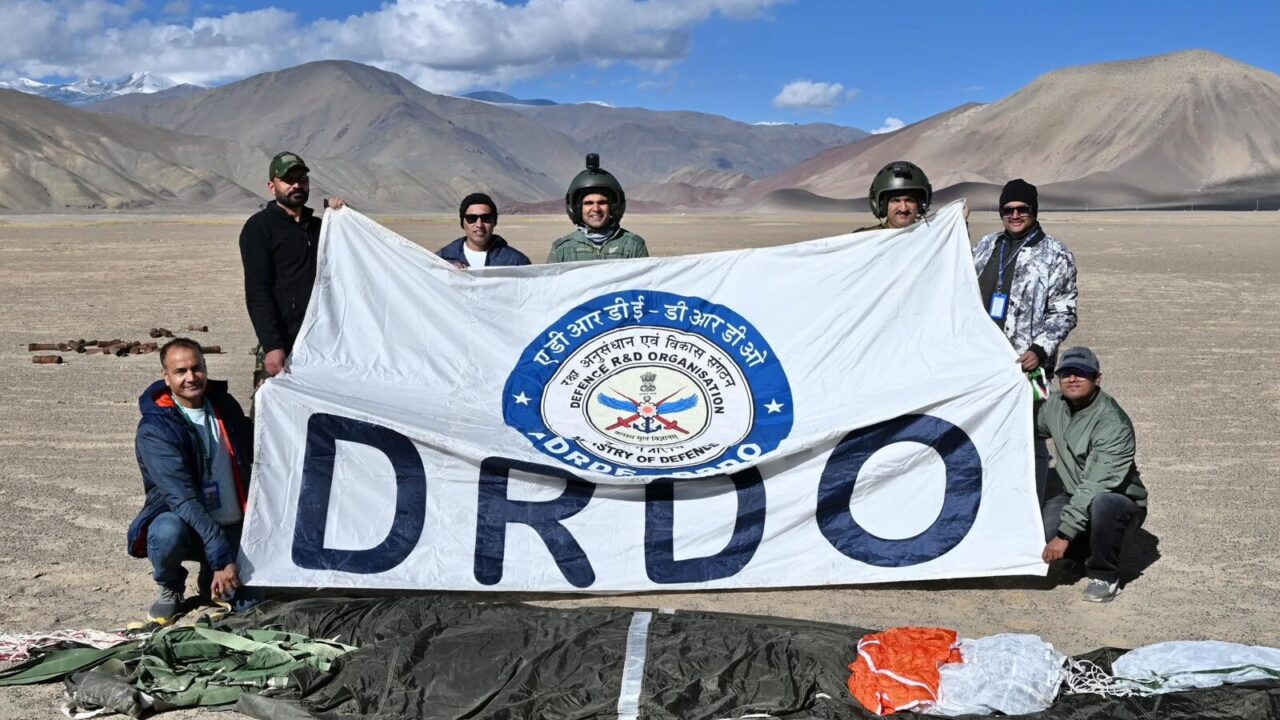
The organisation successfully carried out the maiden flight trial of the Advanced High-Altitude Parachute (AHAP) at one of India’s highest-altitude drop zones, Nyoma (Mudh DZ).
The AHAP is a static-line parachute system designed for the mass drop of paratroopers. The system has been designed and developed by ADRDE, Agra, the same DRDO establishment responsible for the indigenous HAPS development.
What is the Advanced High-Altitude Parachute?
The Advanced High-Altitude Parachute is intended for high-altitude airborne operations and has been developed as a static-line parachute system capable of supporting the mass deployment of paratroopers.
Its maiden flight trial at Nyoma’s Mudh Drop Zone represents an important step in evaluating the system under high-altitude conditions.
High-altitude parachute operations require specialised equipment because reduced atmospheric density and demanding environmental conditions can affect parachute deployment and airborne performance.
The successful trial adds another indigenous capability to India’s portfolio of aerial delivery and airborne-operation technologies.
HAPS and AHAP strengthen India’s indigenous defence technology push
Although the HAPS and AHAP are different systems designed for different operational purposes, both developments highlight DRDO’s efforts to develop indigenous technologies for demanding high-altitude applications.
The HAPS is being developed as a long-endurance stratospheric surveillance platform, while the AHAP is a static-line parachute system for mass deployment of paratroopers.
Both systems have been developed by ADRDE in Agra, demonstrating the establishment’s work across high-altitude surveillance and aerial-delivery technologies.
The HAPS flight, in particular, demonstrated sustained operation at 20 km AMSL for more than 30 minutes, after reaching a peak experimental altitude of 21 km AMSL. The successful recovery and subsequent analysis of flight data will provide DRDO with further information for future development of the platform.
A step towards self-reliant defence capabilities
The latest trials underline India’s broader push to reduce dependence on imported defence technologies and build complex systems domestically.
Developing platforms capable of operating at extreme altitudes involves challenges spanning aerodynamics, navigation, communications, power management, altitude control, payload integration and recovery.
The successful HAPS flight therefore provides an important experimental foundation for the continued development of India’s indigenous high-altitude surveillance capabilities.
The AHAP trial similarly contributes to the development of domestically designed equipment for specialised airborne operations.
Together, these developments demonstrate the expanding scope of India’s indigenous defence research, from stratospheric surveillance platforms to high-altitude parachute systems.
Dharavi Gets a Showroom: Experience Centre Opens as Maharashtra Launches “Invest Maharashtra”Dharavi Gets a Showroom: Experience Centre Opens as Maharashtra Launches “Invest Maharashtra”