


Bo French, the Republican politician whose social-media attacks on South Asian students at the University of Texas at Austin drew national criticism during his 2026 campaign, has lost more than the Texas Railroad Commission election. A letter dated November 10 shows that River Crest Country Club in Fort Worth terminated his membership, with the club’s board citing concerns relating to its “reputation and general welfare”.
The decision came a week after French lost the November 3 election to Democrat Jon Rosenthal. The letter, addressed to French and bearing the River Crest Country Club name, says the board voted in writing by more than two-thirds of all directors to end his membership “effective immediately”. It also says he is no longer eligible for a partial refund of his equity and asks him to surrender his club stock for cancellation.
The document refers to an earlier letter dated October 8 and cites Section 5.2 of the club’s bylaws. It does not specify the conduct that prompted the board’s decision. However, the membership action follows months of public controversy over French’s remarks about South Asian students, immigration and the demographic make-up of the University of Texas. Chron and People have also reported on the club’s decision.
What the River Crest letter says
In the November 10 notice, the board said it had reconsidered French’s conduct and heard his side before taking action under Bylaw Section 5.2. It stated that a written vote by more than two-thirds of the directors had approved the immediate termination of his membership for reasons connected to the club’s reputation and general welfare.
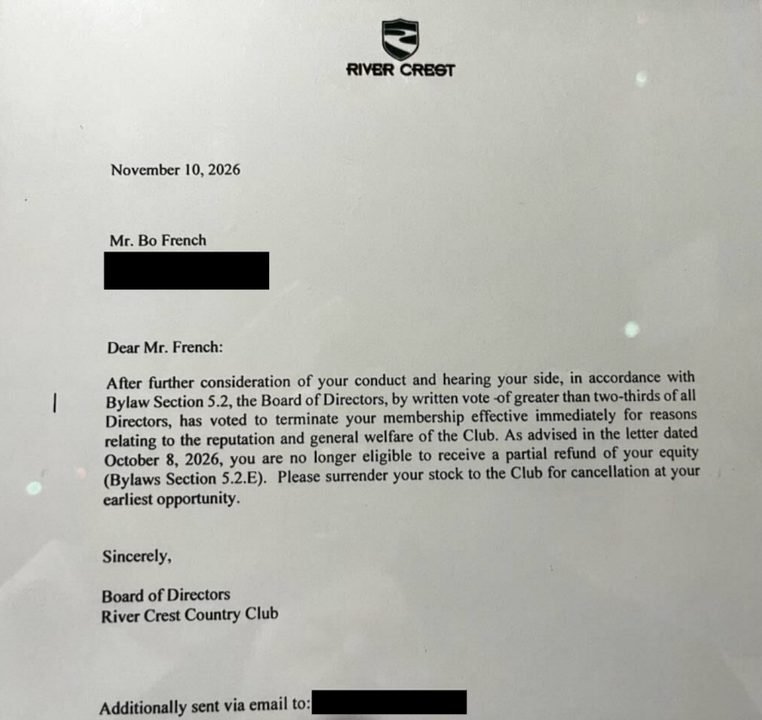
The letter further says French would not receive a partial refund of his equity under Section 5.2.E and directs him to return his stock to the club for cancellation. The wording is significant: River Crest’s letter gives the board’s stated institutional reason, but it does not expressly name his social-media posts or describe them as the specific grounds for expulsion.
More Read
The post targeting South Asian & Indian students that triggered a backlash
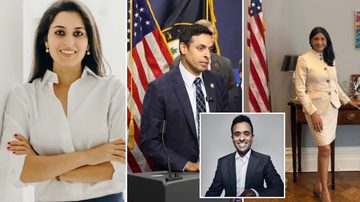
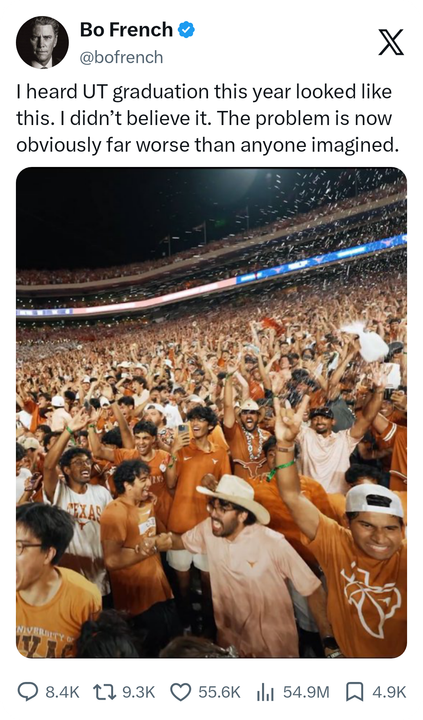
French became a national focus in September after posting an image of South Asian students celebrating the University of Texas Longhorns’ football victory over Ohio State. In a post featuring the students in the stadium, he wrote: “I heard UT graduation this year looked like this,” adding that the situation was “far worse than anyone imagined”
In a separate post, French suggested that the image showed how many Americans had been displaced by “foreigners”. The students in the photograph were targeted online with racist and xenophobic remarks. Their appearance, however, did not establish their citizenship or immigration status, and French offered no evidence that they were foreign nationals.
Students who were targeted described the comments as “disgusting” and said the episode reinforced a sense of hostility they had experienced before. The Texas Tribune reported that some students were dismayed but not surprised by the attacks, while the university later affirmed that the students were part of the Longhorn community.
French defended his remarks and presented them as criticism of university admissions and hiring policies, rather than an attack on people because of their race. But the posts prompted criticism from across the political spectrum. Several Texas Republicans, including US Senator John Cornyn, condemned the remarks.
A campaign increasingly overshadowed by controversy
French was the Republican nominee for the Texas Railroad Commission, the state body that regulates the oil and gas industry — not passenger trains or rail services. His campaign repeatedly focused on cultural and immigration issues, including diversity programmes and the presence of foreign-owned property, even though many such issues fall outside the commission’s core regulatory responsibilities.
The Texas Tribune reported that French’s comments brought unusual national attention to what is normally a low-profile statewide regulatory race. His Democratic opponent, state Representative Jon Rosenthal, sought to keep the contest focused on the commission’s actual work, including oil and gas regulation, environmental safeguards and the agency’s oversight responsibilities. The Texas Tribune’s election analysis examined the contrast between the candidates and the issues that came to dominate the campaign.
On November 3, Rosenthal defeated French, becoming the first Democrat in 32 years to win a seat on the Texas Railroad Commission. The Texas Tribune described the result as a major upset after decades of Republican control of the commission. The race drew attention not only because of the political shift, but also because of the controversies surrounding the Republican nominee.
Election defeat followed by country club expulsion
River Crest Country Club’s decision adds another consequence for French after the election defeat. Founded in 1911, the Fort Worth club is described by local reporting as one of the city’s oldest and most prominent private clubs. Its board’s letter does not publicly detail the deliberations behind the vote, but its reference to reputation and general welfare has drawn attention because it followed the controversy around French’s public conduct.
The sequence is striking: a candidate whose remarks about South Asian students drew criticism from students, university community members and fellow Republicans went on to lose a statewide race, and then received a formal notice ending his membership at a long-established private club. The election result cannot be attributed to one controversy alone, and the club has not publicly said that the social-media posts were the sole reason for its decision. Still, the episode shows how public statements can carry consequences beyond the political arena.
For Indian-origin and other minority communities in the United States, the episode also underlines why public officials and candidates are expected to debate immigration and education policy without singling out students on the basis of appearance or presumed nationality. Criticism of policy is part of democratic debate; treating people as outsiders because they look South Asian is not a substitute for evidence or argument.