

India has added three properties to UNESCO’s World Heritage Tentative List: the Karst-mud-volcano Complex of Baratang and Andaman Subduction Volcanoes in the Andaman and Nicobar Islands, and the Sirpur Cultural and Archaeological Landscape in Chhattisgarh. Inclusion on the Tentative List is an early step in the process not a World Heritage inscription.
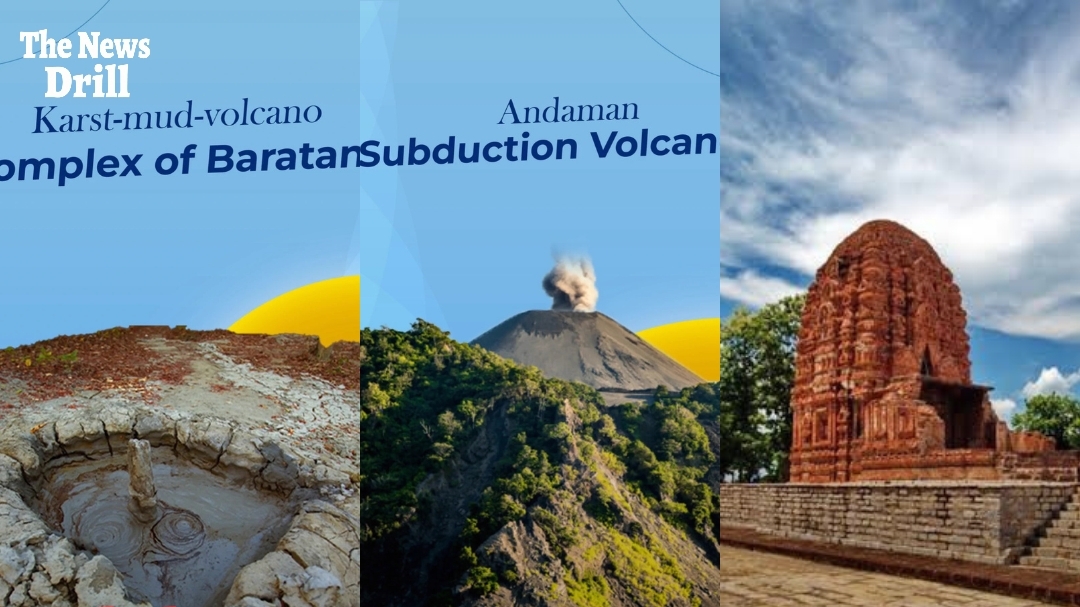
India has added three new properties to its Tentative List under the UNESCO World Heritage Convention, according to a press release issued by the Permanent Delegation of India to UNESCO in Paris dated October 20, 2026. The additions span two geological sites in the Andaman and Nicobar Islands and an archaeological landscape in central India.
The three properties are the Karst-mud-volcano Complex of Baratang, the Andaman Subduction Volcanoes, and the Sirpur Cultural and Archaeological Landscape. The Archaeological Survey of India (ASI) was acknowledged in the release for its work on the submission.
What the three proposed World Heritage sites represent
1. Karst-mud-volcano Complex of Baratang
Baratang Island, part of the Andaman and Nicobar Islands, is known for its distinctive geological features, including limestone formations and mud volcanoes. Karst landscapes develop when soluble rocks—particularly limestone—are gradually dissolved by water, creating features such as caves, cavities and unusual landforms. Mud volcanoes, by contrast, form when mud, water and gases are pushed to the surface from below ground.
More Read

The proposed complex brings attention to the geological processes that have shaped this island environment. Any eventual World Heritage nomination would need to demonstrate the property’s significance against UNESCO’s criteria and provide a plan for its long-term conservation.
2. Andaman Subduction Volcanoes
The Andaman region lies within a tectonically active zone where the Indian Plate descends beneath the Burma microplate along the Sunda-Andaman subduction system. Such plate interactions generate earthquakes and can feed volcanic activity. The wider Andaman volcanic arc includes Barren Island, home to India’s only confirmed active volcano, and the volcanic island of Narcondam.
Placing the Andaman Subduction Volcanoes on the Tentative List highlights the region’s geological importance. The detailed boundaries and features covered by the proposed property should be checked against the official UNESCO submission as further nomination material becomes available.
3. Sirpur Cultural and Archaeological Landscape
Sirpur, in Chhattisgarh’s Mahasamund district, is an important archaeological landscape on the banks of the Mahanadi River. The historic settlement is associated with remains of Buddhist monasteries, Hindu temples and Jain religious sites, reflecting the region’s layered religious and cultural history.
Among Sirpur’s best-known monuments is the brick-built Lakshmana Temple, generally dated to the 7th century and dedicated to Vishnu. Archaeological remains at the site help researchers study historic settlement patterns, religious institutions, architecture and artistic traditions in central India. A nomination would need to establish the property’s proposed boundaries, conservation requirements and the basis for its claimed Outstanding Universal Value.
What UNESCO’s Tentative List means
A place is not a UNESCO World Heritage Site simply because it appears on the Tentative List. Under the World Heritage Convention, a country first identifies properties it considers suitable for possible nomination. A property must be on that list before it can be formally nominated for inscription on the World Heritage List.
The formal nomination process involves a detailed case for the property’s significance, evidence that it meets at least one of UNESCO’s criteria, and a credible framework for protection and management. The nomination is then evaluated before the World Heritage Committee decides whether to inscribe it. Tentative List status is therefore an important preparatory milestone, but it does not guarantee inscription.
India’s World Heritage portfolio
The October 20 press release states that India has 45 properties on the World Heritage List as of October 2026: 37 cultural, seven natural and one mixed. It also puts India’s Tentative List at 81 properties after the three additions. These figures reflect the position stated in the release and should be read separately: the 45 are inscribed World Heritage properties, while Tentative List entries are potential future nominations.
The latest additions broaden the range of Indian places being considered for potential World Heritage recognition—from the geological processes of the Andaman region to the archaeological and cultural history preserved at Sirpur.
Official references: UNESCO World Heritage Tentative Lists; Archaeological Survey of India; Ministry of Culture, Government of India.